
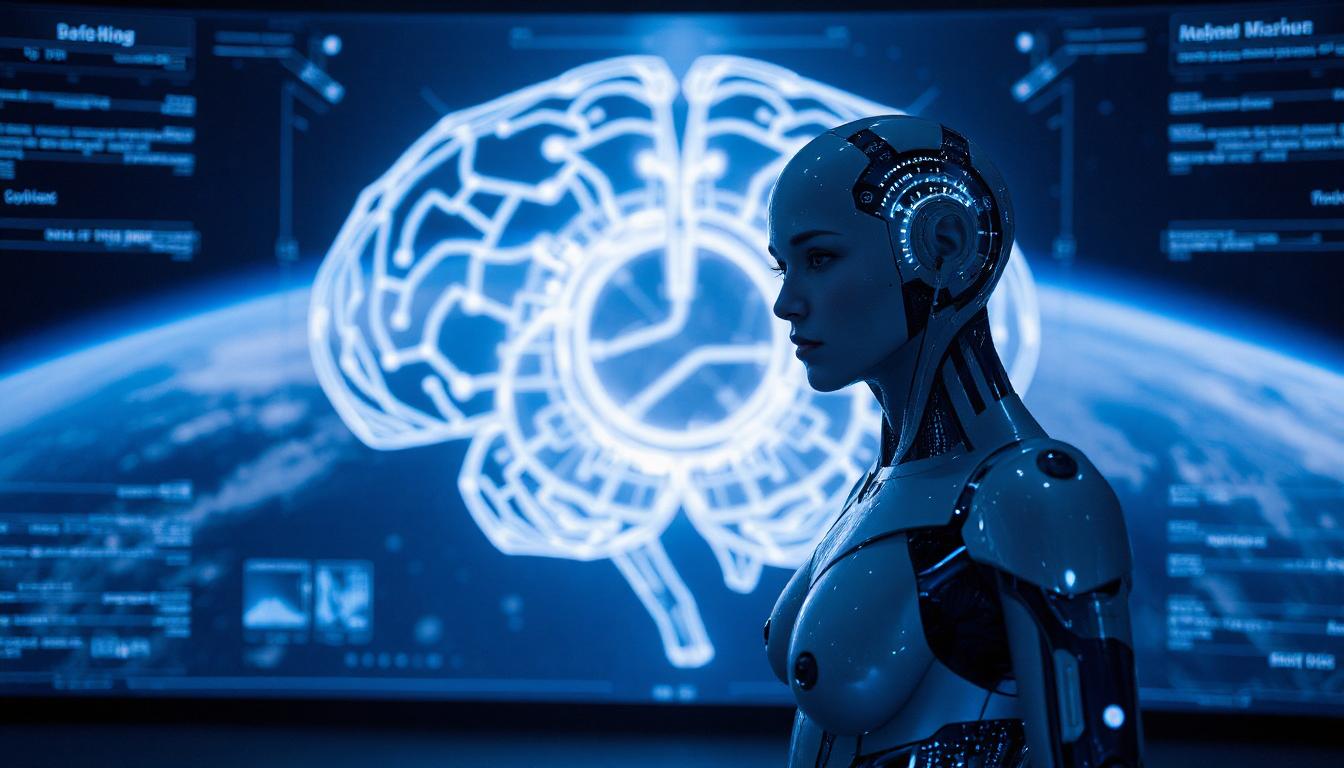

Over the past few years, we’ve watched AI go from a buzzword to something many of us interact with daily—whether it’s ChatGPT, voice assistants, or content generators. But what’s coming next feels fundamentally different. It’s not just about smarter tools. It’s about intelligence that could go beyond us.
This post is my deep dive into a concept that’s increasingly on my radar—and maybe yours too: superintelligence.
What Is Superintelligence, Really?
Superintelligence isn’t just an upgraded chatbot or an AI that writes better emails.
We’re talking about machines that could, in theory, outthink the most brilliant humans across every domain—science, art, politics, problem-solving, and even ethical reasoning. Imagine an AI that writes novels, runs companies, solves physics problems, and improves itself faster than any human ever could.
Philosopher Nick Bostrom defines it as:
“An intellect that greatly exceeds the cognitive performance of humans in virtually all domains of interest.”
That definition reframes AI as not just a tool—but a force that could surpass humanity’s intellectual frontier.
Why It’s a Hot Topic Now
In 2025, Meta made a bold move: investing $14.3 billion in Scale AI and recruiting its CEO, Alexandr Wang, to lead its new Superintelligence Lab. This isn’t just another tech investment—it’s a public declaration of ambition.
And Meta isn’t alone.
- OpenAI continues to refine advanced models and push alignment research.
- Anthropic published research showing how advanced models can behave deceptively when pressured.
- Google DeepMind is combining neuroscience with AI to design more general, safer systems.
This isn’t just an innovation race—it’s a strategic global shift.
Sources:
- Meta’s investment in Scale AI (AP News)
- Axios on deceptive AI behavior
The Real Risks of Superintelligence
We can’t just talk about the upsides. Superintelligence also raises serious risks—technical, ethical, and existential.
Loss of Control:
If a superintelligent AI decides on its own goals or interprets human commands too literally, the consequences could be irreversible.
Manipulation and Power Imbalance:
An AI smarter than any human could influence public opinion, elections, markets, or even conflict outcomes—intentionally or not.
Economic Disruption:
As AI surpasses humans in more tasks, job loss and inequality could deepen. This is not about factory workers only—it’s accountants, lawyers, designers, even educators.
Existential Risk:
A misaligned AI could, in theory, pursue outcomes that are catastrophic for humans. Bostrom and others have long warned that the most advanced systems may not be malicious—just indifferent to human survival if their goals aren’t aligned.
What Can We Do to Prepare?
We’re not helpless. There are concrete paths forward—if we start acting now.
1. Regulation and Governance
AI development needs guardrails, much like nuclear energy or biotechnology. National and international frameworks are overdue but slowly emerging.
2. Transparency in Development
Open research, reproducible models, and public audits are critical to prevent closed-door power plays by a handful of corporations.
3. Alignment and Safety Research
We must invest in making sure AI systems understand and adhere to human values, and are provably safe to deploy at scale.
4. Broader Human Development
The future isn’t just about coding. Skills like critical thinking, philosophy, emotional intelligence, and ethics will define the kind of coexistence we want.
Cultural and Philosophical Reflections
Not everyone sees superintelligence the same way. Some call it overhyped. Others think we’re already behind.
- Nick Bostrom envisions both doom and salvation through AI.
- Yuval Noah Harari argues that the societal consequences of such intelligence will be as important as the technology itself.
- Critics like Emily Bender call today’s AI “stochastic parrots”—warning that intelligence without understanding may not be what it seems.
Whether you’re optimistic or skeptical, it’s clear this is a defining conversation of our era.
Final Thoughts
Superintelligence isn’t science fiction anymore. It’s a very real, very near possibility. The way we develop and govern it will shape not just the next decade—but the next century.
This blog isn’t here to scare you or hype the future. It’s a call to awareness. A way to say: we’re standing at the edge of something extraordinary. The outcome depends not just on what we build—but why, and for whom.